Wednesday, December 23, 2009

December 23 [Emperor's Birthday] class notes

December 23 (The Day After Winter Solstice)
In-Class Writing
(End-of-year) Reflection
Looking back over the past year, please write about your own learning in one of these areas.


  • What I Learned in Writing 4 (and Writing 3) in 2009

  • What I Learned in My English Classes in 2009

  • What I Learned in My Classes at Dokkyo in 2009

  • What I Learned in 2009 (not just in classes)

We will take about 45 minutes. Start now, 13:30 and hand in your work at or before 14:15.

Do you think you are a better writer now? What have you learned? How has your writing changed from what you could do one year ago? Does this affect your writing ability in other languages?

If that topic is too narrow, how about your English skills in general? How have they developed? If they haven't developed well, why not, and what could you do differently in the future?

Looking back at the second year of university, what do you think? has it been as productive as the first year? How was it different? What was the main area of your learning? What would you have missed if you had not been a university student?

In 2009, you may have experienced or learned many things outside of your life as a university student. For example, there were many political changes: a new president of the United States and a new prime minister elected in Japan. You may have made new friends or traveled to strange new places and seen new cultures. Feel free to write on this topic if you prefer!


Our next and final class is January 13, 2009. Please attend, as the plans are to:


  • return your papers and discuss them,

  • complete a self-evaluation,

  • have a small quiz (not a Final Exam, but a check-up),

  • give an opportunity for students who missed December 23 to write their reflections,

  • have your last chance to report any extra credit such as blogging.

Happy holidays! Aloha!

Wednesday, November 25, 2009

Class Notes for November 25

Happy Thanksgiving!

Today I picked up the page 311 Practice 2 homework assignment. We had some time in class and a week to fix up some proper citations from a reference list.

I also referred students to the ScienceDaily web site, where many science news stories include the properly formatted APA and MLA references on the page at the end of the news story. This story would be cited in a blog with a hyperlink (like I just did) but would be cited in a formal paper as


University of Utah (2009, November 24). Is global warming unstoppable?. ScienceDaily. Retrieved November 25, 2009, from http://www.sciencedaily.com­
/releases/2009/11/091123083704.htm
in APA format, or

University of Utah. "Is Global Warming Unstoppable?." ScienceDaily 24 November 2009. 25 November 2009 http://www.sciencedaily.com­
/releases/2009/11/091123083704.htm
.

for the MLA format. (One mistake: It's not indented properly on this blog.)

I reminded students that the content of Chapters 8, 13, 14, and 15 will not be discussed in class, but they can review the contents independently, paying special attention to the review pages on pages 227 for adverbial clauses, page 141 for paraphrase and summaries, page 261 for participial phrases, and page 247 for adjective clauses. The exercises in the chapter (or similar exercises) could become quiz material.

I handed out a sample mindmap and outline for a problem-solution speech which I delivered to students in a speaking class as a model. I never wrote the script for the speech, but just used the outline to guide my mind as I speak. However, the form of it is the same as the written form. I ask whether a problem solution paper is a kind of argumentative essay, and I conclude that it probably is, since I am arguing a point of view, or a course of action. However, I did not spend much time discussing another point of view in my problem-solution outline. You may consider that a weak point, but problem-solution usually focuses just on the problem and the proposed solution more than an argumentative essay would, since it has to deal with the other point of view.

I am accepting revised versions of the first research paper. If you turn it in as a complete folder, I can re-evaluate it and give it a new (higher!) score.

We went through the beginnings of Chapter 9 in order to know more about the argumentative essay. We are up to page 145, and we previewed the chapter. I assigned students to create a mind-map (diagram) of their ideas for the argumentative essay as a first step and homework.

Wednesday, November 18, 2009

Class Notes for November 18, 2009

I posted some content from last week below, and collected the homework assignment of page 212 practice 1 A and B from anyone who didn't turn it in last week. Compare/Contrast Papers were returned to all students who had done them with evaluation worksheets attached. Some of these papers had no Outline, no References list ("Works Cited" list) and other parts missing. For that reason, I asked some (and all) to make any changes that you can to improve the paper and earn more points as you perfect it! You may make corrections to your final draft and produce a Corrected Final Draft and turn it in to me. I will happily accept a Corrected Final Draft and will re-score the Project Folder with your new work!

Page 311 Practice 2 was given as homework, and some peoplestarted working on it in class. I will pick it up next week. It is acceptable to use a "citation generator" to help you learn to format it properly.

As I said last week, you should try to review Chapters 8, 14, and 15 outside of class. We are looking forward to Chapter 9, the Argumentative Essay as a large final assignment, so begin to prepare by thinking of topics you would like to write about, and by doing some research.

"Citation Machines" or "Citation Generators"

Are you having trouble remembering how to format a reference in your Reference List ("Works Cited" list)? If so, try out these Citation Generators.

http://citationmachine.net/

http://www.palomar.edu/dsps/actc/mla/

http://www.calvin.edu/library/knightcite/index.php

http://www.amacite.com/http://www-aws.easybib.com/


You just enter the data and let the computer format it. Isn't that easy? Actually, I think it is a little bit slower in some ways than just doing it yourself. It also makes some small mistakes sometimes. Give it a try anyway if you want to check your References or get used to the style.
Below is more about MLA (Modern Language Association) and APA (American Psychological Association) citation styles.

APA CITATION FORMAT

http://library.rit.edu/pubs/guides/apa.html

http://www.lesley.edu/library/guides/citation/apa.html

in-text citation
http://www.byui.edu/english/mlaguide/MLA_intext_citation.htm


MLA Bibliographic Style--A Brief Guide

http://www.sdst.org/shs/library/mla.html

http://www.sdst.org/shs/library/mla.html

A.P.A., M.L.A., H.E.L.P.!

As I mentioned last week, you may find it confusing that last year's textbook used APA style, this year's textbook uses MLA style, and other teachers use another style of citation and reference!

In this class, either MLA or APA will be acceptable. Interestingly, the Wikipedia also has a similar policy, requiring that each page be consistent within itself. This is true for your paper as well. Do not mix and match the styles (if you can avoid it)!

Here are some online links I thought were good. The information on this site is also available in a print booklet,

Research and Documentation in the Electronic Age, Fourth Edition, by
Diana Hacker
http://www.dianahacker.com/resdoc/
MLA in-text citations
http://www.dianahacker.com/resdoc/p04_c08_s1.html
MLA list of works cited
http://www.dianahacker.com/resdoc/p04_c08_s2.html
APA in-text citations
http://www.dianahacker.com/resdoc/p04_c09_s1.html
APA List of References
http://www.dianahacker.com/resdoc/p04_c09_s2.html

When to cite sources

Most students have still not ever cited any sources. When do we cite sources? The short answer is that EVERY FACT gets a citation. A longer answer can be found in the Wikipedia.

When to cite sources
Wikipedia is by its very nature a work by people with widely different
knowledge and skills. The reader needs to be assured that the material
within it is reliable.

The purpose of citing sources is:
. To ensure that the content of articles can be checked by any reader or editor.
. To show that your edit is not original research and to reduce editorial
disputes.
. To avoid claims of plagiarism and copying.
. To help users find additional information on the topic.
. To ensure that material about living persons complies with biography policy.
. To improve ...credibility .... Since each fact presented by an
article must be concretely verifiable, at the editor's discretion it is
possible and appropriate to include as many proper and
correct citations as desired to affirm the statements made. However
citation is only required as specified in the following list of
circumstances. And whether a citation is added in a required context or at
an editor's discretion it must be accurate and should comply with the rules
set forth in this guideline.When adding material that is challenged or
likely to be challenged.

"All quotations and any material challenged or likely to be
challenged should be attributed to a reliable, published source using an
inline citation."The need for citations is especially important when
writing about opinions held on a particular issue. Avoid weasel
words where possible, such as, "Some people say ..."
Instead, make your writing verifiable: find a
specific person
or group who holds that opinion and give
a citation to a reputable publication in which they express that
opinion. .... Opinions, data and statistics, and statements based
on someone's scientific work
should be cited and attributed to their
authors in the text.

When quoting someone...


I hope that helps!

Wednesday, November 4, 2009

Class Notes

November 4, 2009

Return old papers
Checklist (p. 328)
.....My Essay Checklist
.....(Based on the Chronological Essay)
.....(Modify a little for Comparison and Contrast)
Samples
.....Title Page
.....Reference Page
Self-Editing finished? (Have you examined your work for obvious mistakes?)
Peer Editing (Exchange papers with another student)
Final Proofreading (last-minute changes or additions)
Pick up the essays to evaluate

Ch. 13 Adverb (Adverbial) Clauses
Homework: Type (or write up) Practice 1, A and B, pp 212-213.

Look ahead to the Argumentative Essay (major assignment in Ch. 9)

Essay Contest at another university
http://2009w2.blogspot.com/
.....Sharing
.....Reading
.....Voting
.....Learning from others
Sharing essays
.....post it on your blog?
.....mail it to the teacher?

Wednesday, October 14, 2009

Class Notes

Wednesday, October 14 class (3rd week)

Noun Clauses (Chapter 12)
Collect Homework pp 200-202, Practice 3, Practice 4, Practice 5
Editing page 208 (as a group in class)
(optional assignment to consider in the future: interview questions or a business/job inquiry letter)

Appendix D: Editing Symbols
Worksheet activity: Editing sample (Find and mark the errors with correction symbols.)

Appendix E: Reference and Citation
We will return to this topic when we need to practice it after finding references for our papers.

Chapter 7: Comparison/Contrast
A brief look at page 111 and the sample essay on page 112-113
The structure of the sample essay
Having a topic which is not too broad or too narrow

For next week:
1. Select Your topic (and check it with the teacher),
2. Make your mindmap (which will later become an outline),
3. Find (at least) two references, preferably (one or both) from 2009.

Wednesday, October 7, 2009

Homework

Homework for October 7-14
Chapter 12: Noun Clauses

Type these to hand in:
Practice 3, page 200-201, Numbers 2-8
Practice 4, page 202-203 Letter (#1-10)
Practice 5, page 204-205 Letter (1-10)

Wednesday, July 1, 2009

Class Notes for July 1

Today, I returned last week's homework on quotations and writing that was based on data from a graph. We discussed the proper punctuation for quotations, and the way that indirect quotations have grammatical changes from the original words.

I handed out my own document as a substitute for the simple rubric on page 316. The Chronological Order Essay Evaluation Checklist has more detailed questions about many details we learned in class, and can be used for self-editing and peer-editing.

Some people have already written their first draft completely. Congratulations! Next week we will try to do some peer-editing and self-editing of your second draft. You can also use most of the ideas in the Chronological Order Essay Evaluation Checklist to guide you in your Cause-and-Effect Essay.

Here are some suggestions for the more advanced writers:
  • Make a longer and more detailed outline. Some of your outlines are two simple. There should be at least 10 elements (or items) in your outline, as a rule of thumb.
  • Lengthen your paper. Make it at least 5 paragraphs long, and add more details, examples, and explanation to your arguments.
  • Add support. Does your paper have a quotation with a citation and reference? Add one. Have you added facts and statistics (with a citation and reference) to support your claims? Add some. Have you given examples (possibly with citations and references) to explain and illustrate your points? Try it.
  • Make sure you have done your research, written a logically organized paper, and included citations and a reference list.

Rest in Peace (a musical tribute)

Michael Jackson died last Friday (Japan time). I was not a fan of his work but I did appreciate the Jackson Five, a pop group that was very popular with both children and adults due to Michael Jackson's uncanny singing ability. Their music changed America and was a sign of relaxing racial tensions and better relations between African-Americans and Anglo-Americans. Perhaps their music helped create the environment in which Barack Obama could be elected president.

This is the Jackson Five - I WantYou Back (probably 1968 - 1970). Michael is talented. As a child star, his future seemed promising.


Here is the same song performed a few years later in 1972 on Soul Train, a popular black music show. MJ was 13. Check out the fashions and dancing at that time!


I'll Be There was another one of the Jackson Five's great songs. This clip also has Diana Ross (it was her TV special) and Feelin' Alright.

Wednesday, June 24, 2009

Class notes for June 24 (week 11 of 14)

Today I picked up student homework for Chapter 3 (see below). We reviewed the main points of the chapter (SUPPORTING DETAILS: Facts, Quotations, and Statistics).

Then we began to discuss Chapter 6 (CAUSE AND EFFECT). We talked about causes, effects, chain-reaction style papers, most of the main ideas of the chapter and some of the exercises. In the next few weeks, we will write (or build) our own cause-and-effect papers.

Today we began with topic selection. I gave some example cause-and-effect topics from business, science, music, art, and so on. Then I walked around and found that most of you were coming up with your own interesting topics. I was impressed. You should make a Mindmap (or diagram) of the cause(s) and/or effect(s) that you are writing about. Most of your topics will require real research to find out more about the causes or effects. Be sure to write a citation in the text and list a reference at the end of the paper for these supporting details.

For next week: Make a formal outline (based on your mind-map/diagram). It will act as a plan--but it is possible to change the plan later as you write. You should have a rough draft: some or all of your paper in a rough form. If you can write at least an introduction and part of the body, that may be sufficient. If possible, write the whole paper. You will need a week or two to edit it and catch all of the mistakes, to add citations and references, and so on.

Wednesday, June 17, 2009

Class notes from June 17

June 17, 2009

Today, I returned some old homework.

I asked you to review your Process Essay before turning it in. We talked about including earlier drafts and all related documents in yout Project Folder, using chronological order: the newest, final document in the front. I asked you to include the Peer Editing WS and the Self Editing Worksheet (if you have done them) to check yourself and get another person to check what you have done.

Then we talk about Chapter 3: Supporting Details, and did some exercises in class.

This is your Homework for June 24:
__ Page 46 Practice 2, Sentences #3 and #4
__ Page 49 Practice 3, #1-4
__ Page 52 Practice 5

We will start Chapter 6: the Cause-and-Effect essay next week and choose a topic. We may sign up or write down our topic in class, and I will check if it is really Cause-and-Effect.)

Wednesday, May 20, 2009

How Dangerous is the New Flu for you?

From the Washington Post:

Age of Flu Victims Has Big Implications
Scientists Say Relative Youth of Ill People Is Evidence of Pandemic Potential

By
David Brown Washington Post Staff Writer Sunday, May 17, 2009


The swine-origin influenza A (H1N1) virus that burst into public consciousness a month ago is starting to behave like a mixture of its infamous, pandemic-causing predecessors. It seems to have a predilection for young adults, as did its notorious ancestor, the 1918 Spanish influenza. Many of the young victims who have become deathly ill turned out to have other medical problems -- a phenomenon first clearly seen with the 1957 Asian flu. H1N1 is spreading easily
in North America but sputtering in Europe, just as Hong Kong flu did in 1968. And as in the mini-pandemic of Russian flu in 1977, some people appear to have a degree of immunity.

...

Perhaps the most worrisome features so far are the number and severity of cases in teenagers and young adults. This was noticed early, and the pattern has not changed much now that there are 5,000 laboratory-confirmed infections and probably more than 100,000 overall. The average age of the confirmed and probable cases is 15 years. Two-thirds are younger than 18.


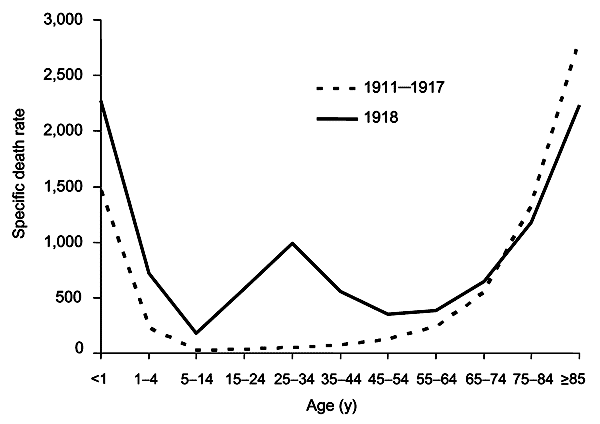
One of the scary things about the new influenza is that it attacks young adults in their prime. This also happened in the 1918 influenza, which may have killed as many as 100,000,000 people around the world. There is a tendency to have a W-shaped mortality curve instead of the usual U-shaped curve. In other words, instead of killing small children and the elderly, the new influnza kills them PLUS people around 20 to 40 years old. The reason is that these people have a strong immune system which fights the virus too hard, and ends up destroying the lung cells. When your lungs die, you die.
The strange thing about this flu was that it killed hearty 20- to 40-year-olds. Infants and the elderly also died, but mortality rates spiked among those with supposedly the strongest immune systems.

From the Wikipedia:

Among the conclusions of this research is that the virus kills via a cytokine storm (overreaction of the body's immune system) which explains its unusually severe nature and the concentrated age profile of its victims. The strong immune systems of young adults ravaged the body, whereas the weaker immune systems of children and middle-aged adults caused fewer deaths.

Japan is now one of 4 or 5 countries most severely affected by the new influenza! Because of this and because we still do not understand its nature, how easily it is spread, how deadly it is, and so on, we must be very cautious and not let down our guard. Take care of your health!

May 20, 2009 Class Notes

Today we reviewed Chapter 10 (Types of Sentences), Appendix A (The Academic Writing Process, Chapter 2 (Unity and Coherence) and began Chapter 5. Chapter 5 is about Process Essays (How-to essays and How-Things-Work), a type of writing which uses chronological order (time order).

Homework for May 20-May 27

_ How to Annoy a Teacher (page 88). Please type out the sentences and underline the answers.

_ Essay Preparation (First Stage):
__ Choose the topic of your Process Essay (e.g. How to Bake a Cheesecake)
__ Make a plan (Cluster diagram or Outline) of your essay (see page 75-77 for an example)
__ Write the thesis statement of your process essay (page 84-85 may help you)

Wednesday, April 29, 2009

Syllabus

This picture is an overview of our syllabus and how our textbook will be used to support our learning. 

Note that Part I, Part III, and the Appendices contain much review material. Part II is mostly new types of essays. In order to spread out the essay work evenly throughout the semester and over the two semesters, the sequence of chapters has been changed. In the first semester, we will write a Process Essay and a Cause and Effect Essay. In the second semester, Comparison and Contrast and Argumentative Essays are scheduled, as well as some additional paraphrase and summary work. 

Textbook

Our textbook is Oshima & Hogue, "Writing Academic English" (Level 4), Longman; ISBN-13: 978-0-13-1523593 (4th Edition) 


Last Year's Writing course blog

During one semester last year, we did a little bit of blogging to support what we were studying.
http://e3writing.wordpress.com/

Hello

Blogging
April 29, 2009

You may already have a Google account if you used Google Docs or GCal or Gmail or Blogger or Picasa web albums or any other Google service. If you do not already have a Google account, it is very easy to make one.

You can control many points about your blog, such as whether search engines can find it, who can read it, who can make comments on it, and so on.

Why?

_ Start Writing Regularly
_ Improve your fluency in writing, your ease of
expression, vocabulary, and grammar.
_ Blogging has some similarities to
academic writing. For example, the Funnel Introduction, capturing your reader’s
attention, paragraph structure, essay structure, conclusions, citing sources
(with hyperlinks or with an academic citation).
_ A blog is lighter than a
physical journal or notebook. A blog has no weight. Also, you can write in it
while someone is reading it (at the same time). You can interact with many
different people.

What?
What should I write about?

_ Academic topics
_ Classes at school
_ News
_ Thoughts, ideas, opinions
_ Language learning
_ Something that might be of interest to other people
_ Daily life?

Be careful to protect your own privacy.