Age of Flu Victims Has Big Implications
Scientists Say Relative Youth of Ill People Is Evidence of Pandemic Potential
By David Brown Washington Post Staff Writer Sunday, May 17, 2009
The swine-origin influenza A (H1N1) virus that burst into public consciousness a month ago is starting to behave like a mixture of its infamous, pandemic-causing predecessors. It seems to have a predilection for young adults, as did its notorious ancestor, the 1918 Spanish influenza. Many of the young victims who have become deathly ill turned out to have other medical problems -- a phenomenon first clearly seen with the 1957 Asian flu. H1N1 is spreading easily
in North America but sputtering in Europe, just as Hong Kong flu did in 1968. And as in the mini-pandemic of Russian flu in 1977, some people appear to have a degree of immunity....
Perhaps the most worrisome features so far are the number and severity of cases in teenagers and young adults. This was noticed early, and the pattern has not changed much now that there are 5,000 laboratory-confirmed infections and probably more than 100,000 overall. The average age of the confirmed and probable cases is 15 years. Two-thirds are younger than 18.
One of the scary things about the new influenza is that it attacks young adults in their prime. This also happened in the 1918 influenza, which may have killed as many as 100,000,000 people around the world. There is a tendency to have a
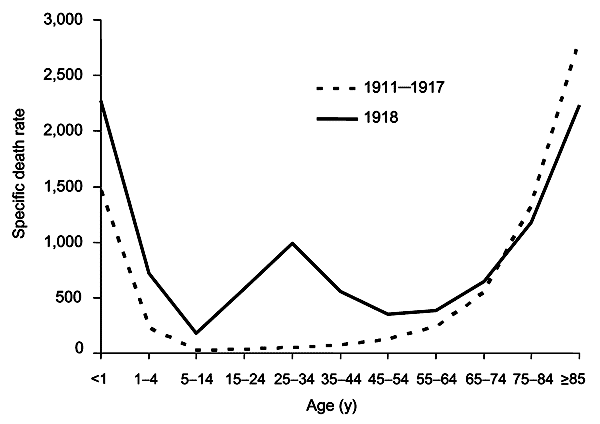 W-shaped mortality curve instead of the usual U-shaped curve. In other words, instead of killing small children and the elderly, the new influnza kills them PLUS people around 20 to 40 years old. The reason is that these people have a strong immune system which fights the virus too hard, and ends up destroying the lung cells. When your lungs die, you die.
The strange thing about this flu was that it killed hearty 20- to 40-year-olds. Infants and the elderly also died, but mortality rates spiked among those with supposedly the strongest immune systems.
From the Wikipedia:
Japan is now one of 4 or 5 countries most severely affected by the new influenza! Because of this and because we still do not understand its nature, how easily it is spread, how deadly it is, and so on, we must be very cautious and not let down our guard. Take care of your health!Among the conclusions of this research is that the virus kills via a cytokine storm (overreaction of the body's immune system) which explains its unusually severe nature and the concentrated age profile of its victims. The strong immune systems of young adults ravaged the body, whereas the weaker immune systems of children and middle-aged adults caused fewer deaths.


