Wednesday, June 24, 2009

Class notes for June 24 (week 11 of 14)

Today I picked up student homework for Chapter 3 (see below). We reviewed the main points of the chapter (SUPPORTING DETAILS: Facts, Quotations, and Statistics).

Then we began to discuss Chapter 6 (CAUSE AND EFFECT). We talked about causes, effects, chain-reaction style papers, most of the main ideas of the chapter and some of the exercises. In the next few weeks, we will write (or build) our own cause-and-effect papers.

Today we began with topic selection. I gave some example cause-and-effect topics from business, science, music, art, and so on. Then I walked around and found that most of you were coming up with your own interesting topics. I was impressed. You should make a Mindmap (or diagram) of the cause(s) and/or effect(s) that you are writing about. Most of your topics will require real research to find out more about the causes or effects. Be sure to write a citation in the text and list a reference at the end of the paper for these supporting details.

For next week: Make a formal outline (based on your mind-map/diagram). It will act as a plan--but it is possible to change the plan later as you write. You should have a rough draft: some or all of your paper in a rough form. If you can write at least an introduction and part of the body, that may be sufficient. If possible, write the whole paper. You will need a week or two to edit it and catch all of the mistakes, to add citations and references, and so on.

Wednesday, June 17, 2009

Class notes from June 17

June 17, 2009

Today, I returned some old homework.

I asked you to review your Process Essay before turning it in. We talked about including earlier drafts and all related documents in yout Project Folder, using chronological order: the newest, final document in the front. I asked you to include the Peer Editing WS and the Self Editing Worksheet (if you have done them) to check yourself and get another person to check what you have done.

Then we talk about Chapter 3: Supporting Details, and did some exercises in class.

This is your Homework for June 24:
__ Page 46 Practice 2, Sentences #3 and #4
__ Page 49 Practice 3, #1-4
__ Page 52 Practice 5

We will start Chapter 6: the Cause-and-Effect essay next week and choose a topic. We may sign up or write down our topic in class, and I will check if it is really Cause-and-Effect.)

Wednesday, May 20, 2009

How Dangerous is the New Flu for you?

From the Washington Post:

Age of Flu Victims Has Big Implications
Scientists Say Relative Youth of Ill People Is Evidence of Pandemic Potential

By
David Brown Washington Post Staff Writer Sunday, May 17, 2009


The swine-origin influenza A (H1N1) virus that burst into public consciousness a month ago is starting to behave like a mixture of its infamous, pandemic-causing predecessors. It seems to have a predilection for young adults, as did its notorious ancestor, the 1918 Spanish influenza. Many of the young victims who have become deathly ill turned out to have other medical problems -- a phenomenon first clearly seen with the 1957 Asian flu. H1N1 is spreading easily
in North America but sputtering in Europe, just as Hong Kong flu did in 1968. And as in the mini-pandemic of Russian flu in 1977, some people appear to have a degree of immunity.

...

Perhaps the most worrisome features so far are the number and severity of cases in teenagers and young adults. This was noticed early, and the pattern has not changed much now that there are 5,000 laboratory-confirmed infections and probably more than 100,000 overall. The average age of the confirmed and probable cases is 15 years. Two-thirds are younger than 18.


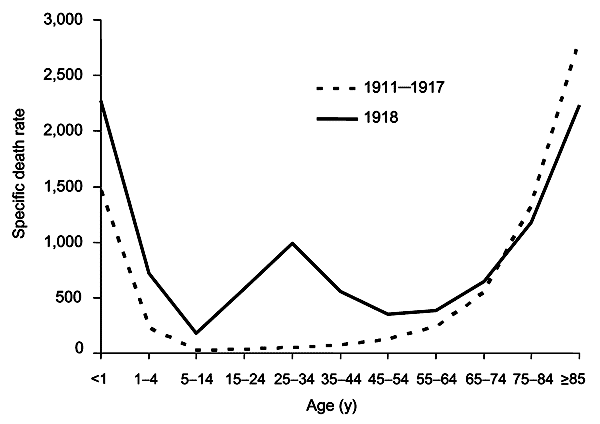
One of the scary things about the new influenza is that it attacks young adults in their prime. This also happened in the 1918 influenza, which may have killed as many as 100,000,000 people around the world. There is a tendency to have a W-shaped mortality curve instead of the usual U-shaped curve. In other words, instead of killing small children and the elderly, the new influnza kills them PLUS people around 20 to 40 years old. The reason is that these people have a strong immune system which fights the virus too hard, and ends up destroying the lung cells. When your lungs die, you die.
The strange thing about this flu was that it killed hearty 20- to 40-year-olds. Infants and the elderly also died, but mortality rates spiked among those with supposedly the strongest immune systems.

From the Wikipedia:

Among the conclusions of this research is that the virus kills via a cytokine storm (overreaction of the body's immune system) which explains its unusually severe nature and the concentrated age profile of its victims. The strong immune systems of young adults ravaged the body, whereas the weaker immune systems of children and middle-aged adults caused fewer deaths.

Japan is now one of 4 or 5 countries most severely affected by the new influenza! Because of this and because we still do not understand its nature, how easily it is spread, how deadly it is, and so on, we must be very cautious and not let down our guard. Take care of your health!

May 20, 2009 Class Notes

Today we reviewed Chapter 10 (Types of Sentences), Appendix A (The Academic Writing Process, Chapter 2 (Unity and Coherence) and began Chapter 5. Chapter 5 is about Process Essays (How-to essays and How-Things-Work), a type of writing which uses chronological order (time order).

Homework for May 20-May 27

_ How to Annoy a Teacher (page 88). Please type out the sentences and underline the answers.

_ Essay Preparation (First Stage):
__ Choose the topic of your Process Essay (e.g. How to Bake a Cheesecake)
__ Make a plan (Cluster diagram or Outline) of your essay (see page 75-77 for an example)
__ Write the thesis statement of your process essay (page 84-85 may help you)

Wednesday, April 29, 2009

Syllabus

This picture is an overview of our syllabus and how our textbook will be used to support our learning. 

Note that Part I, Part III, and the Appendices contain much review material. Part II is mostly new types of essays. In order to spread out the essay work evenly throughout the semester and over the two semesters, the sequence of chapters has been changed. In the first semester, we will write a Process Essay and a Cause and Effect Essay. In the second semester, Comparison and Contrast and Argumentative Essays are scheduled, as well as some additional paraphrase and summary work. 

Textbook

Our textbook is Oshima & Hogue, "Writing Academic English" (Level 4), Longman; ISBN-13: 978-0-13-1523593 (4th Edition) 


Last Year's Writing course blog

During one semester last year, we did a little bit of blogging to support what we were studying.
http://e3writing.wordpress.com/

Hello

Blogging
April 29, 2009

You may already have a Google account if you used Google Docs or GCal or Gmail or Blogger or Picasa web albums or any other Google service. If you do not already have a Google account, it is very easy to make one.

You can control many points about your blog, such as whether search engines can find it, who can read it, who can make comments on it, and so on.

Why?

_ Start Writing Regularly
_ Improve your fluency in writing, your ease of
expression, vocabulary, and grammar.
_ Blogging has some similarities to
academic writing. For example, the Funnel Introduction, capturing your reader’s
attention, paragraph structure, essay structure, conclusions, citing sources
(with hyperlinks or with an academic citation).
_ A blog is lighter than a
physical journal or notebook. A blog has no weight. Also, you can write in it
while someone is reading it (at the same time). You can interact with many
different people.

What?
What should I write about?

_ Academic topics
_ Classes at school
_ News
_ Thoughts, ideas, opinions
_ Language learning
_ Something that might be of interest to other people
_ Daily life?

Be careful to protect your own privacy.